
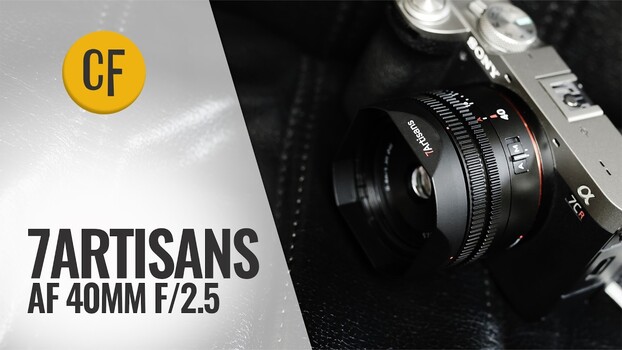

The 7Artisans 40mm f/2.5 arrives with a price that undercuts almost everything else in the full frame autofocus market. If you like small lenses and natural perspectives, this one raises a simple question: how much do you really need to spend?
Coming to you from Christopher Frost, this thorough video takes a close look at the 7Artisans 40mm f/2.5, a 90 g autofocus lens launching for Sony E with L-Mount and Nikon Z versions on the way. You get a plastic body with a metal mount and even a thin weather-sealing gasket. There is a USB-C port for firmware updates, which you do not often see at this price. The aperture ring clicks in one-third stop increments and has a firmer detent when switching to camera-controlled mode, which helps prevent accidental changes. The manual focus ring works, though it steps in larger increments than expected, making fine adjustments at close distances a little awkward.
Autofocus is accurate and quiet, but not quick. In single and continuous modes it responds steadily, without snapping into place. There is noticeable focus breathing, with the image tightening up as you focus closer. The minimum focus distance is 40 cm, which keeps it in general-purpose territory rather than close-up specialist. No image stabilization is built in, and the front filter thread is 46 mm. The included hood is simple plastic, but practical, and the cap remains easy to remove with the hood attached.
Image quality is where things get interesting. Tested on a 61-megapixel Sony a7CR, the lens delivers strong central sharpness at f/2.5 with only minor purple fringing. Stop down to f/4 and the center becomes bitingly sharp. Corner performance at f/2.5 is better than expected for $159, with decent detail and contrast, though not matching the center. By f/5.6, the frame looks impressively even. Diffraction softening appears at f/11 and becomes clearer at f/16. On APS-C, using the a7CR’s crop mode, results remain solid, especially from f/4 onward.
Turn off in-camera corrections and you will see noticeable pincushion distortion and clear vignetting at f/2.5. By f/5.6, illumination evens out. Flare is the lens’s weakest point. When bright light hits the front element, contrast drops hard, with obvious ghosting and internal reflections. Stopping down helps, but does not eliminate the issue. Coma at f/2.5 is visible but controlled by f/4, and largely gone at f/5.6. Sunstars begin to look defined around f/11 and become more pronounced at f/16.
Background blur is decent for a 40mm f/2.5. Get close to your subject and you can separate it from the background with reasonably smooth rendering and clean specular highlights. Chromatic aberration shows up at f/2.5, improves at f/4, and is mostly absent by f/5.6.
You end up with a lens that is extremely light, genuinely sharp for the money, and limited mainly by flare control and modest autofocus speed, and the video goes deeper into sample images and real-world use that help clarify whether those tradeoffs fit the way you shoot. Check out the video above for the full rundown from Frost.